Monday, 27 February 2017

Levuka Days

There's been a birthday in February. If you happened upon the Facebook or Twitter feeds, you'll be familiar with me saying I knew it was my birthday in a globalised world because Google said so, and in Fiji because it said 'Ma'am' on the cake.


I've tried - and managed for a number of years now - to do something retreat-like around my birthday and have a bit of a think and a pray. I've managed this each year in Fiji so far: 2015 in Sydney for Holy Week (a few weeks' later than the actual birthday, but never mind), 2016 in orchid gardens four days pre-Cyclone, and this year in Levuka, Fiji's first capital.

I went early Saturday morning. A 12 min Northern Air island-to-island hop at an exquisite height of 1000 feet (so, so stunning....) and no tedious faffing about, up-ing and down-ing the wheels. Returned early Monday.

Settled on a theme of 'vocation' as the reflective focus. Took some helpful reading which I'll come back to in a minute. The idea of a quiet, solo retreat is a bit odd to colleagues here in a culture which is so community and family orientated. It generates a sort of quizzical, 'Where's she going and what's she up to?' kind of interest. Tourism we get: there's a lot of it about. But this? The RCs understand.


Levuka took a bad hit from Cyclone Winston a year ago and is still recovering. It's a gentle, beautiful, atmospheric city, oozing character, on Ovalau island which is lush, volcanic, and about 180 square km in size. A population of about 8000 people mostly live in villages around the coast and inside the crater of Lovoni. Levuka has 1/4 of Ovalau's population. Farming and fishing are the main sources of income and the main local employer is a tuna cannery.


Levuka was named Fiji’s first World Heritage Site in 2013 by UNESCO because it combines natural beauty, 19th century architecture and heartstopping ocean views, under the shade of coconut and mango trees.The tourism leaflet in my room listed proudly a number of Fiji’s historical firsts which occurred there: the first public school was established there in 1879; the first Masonic Lodge in the Pacific Islands in 1875; Fiji’s first newspaper, the Fiji Times in 1869; and the first bank, the Bank of New Zealand, opened there in 1876. Of these, the school and the lodge still stand, as does the oldest operating hotel in the South Pacific, the Royal Hotel, opened in the late 1850s. That's where I stayed in absolutely fascinating worn and faded colonial 'splendour'. A second floor room, cold water only, where everything from floorboard to headboard wobbled, groaned and creaked. A bit like the occupant, really. I hardly saw a soul and it was nourishing, reflective space.


8am Mass on Sunday at the Sacred Heart (built in 1858 by the Marist Fathers) was appreciated....


...as was some quiet time in one of the Wesley Division's Methodist churches, where the faithful are still worshipping under a temporary roof since Cyclone Winston.


I started reading William Placher's amazing collection of writings on the theme of vocation gathered from a broad swathe of Christian history. A varied menu and well worth chewing on. 

His concern about Churches being too cautious when it comes to challenging younger people seriously and radically about faith, I found refreshing. It's a reflection from outside the Pacific though and that struck me as I thought about context here. Fiji churches aren't cautious at all about urging faith commitment with action among young people, it seems to me. They just go for it.

Here's a short extract from Placher's thinking.


I'm no Spring chicken these days, as the birthday reminded me. But I realise how fortunate I was to have been taken seriously back in the teenage and young adult years as faith was forming. And to have been challenged about faith and life choices.

Levuka has a Mission Hill with 199 steps. It's well worth the climb and the resulting view. And there could be worse places for futher vocational reflection.


Thanks, Levuka.


Does God not see 
my ways and
number all my 
steps?


 Job 31.4


Friday, 10 February 2017

Called to High Office

It's been the week for inducting Prefects in the schools of Fiji, and I've gained a whole, new appreciation of how phenomenally important that is in the lives of many families. We made a fuss of Sau and Lena, members of Nanuku Youth Group as they took up prefect status at St Marcellin, Vatuwaqa. But further away in Nausori, Rev Paulina Vuicuvu Naimawi was celebrating her son Justin's enrolment. Here's what she wrote as a proud Mum.

Dilkusha Boys School Induction Service at Dilkusha Church today. Thank God for my son, Luke Justin. T. Naimawi who has been chosen by Him and the school to be a school prefect in his final year at Dilkusha Boys School. To God be the glory.


Rev Pau teaches Biblical Studies at the Methodist Theological College and is a good friend to PTCEE because she does some marking for us. Always grateful for that. We'll meet at PTCEE Advisory Committee this coming week and so I'll ask how the new prefect's getting on and about any early adventures! 

On the same theme, here's a moving piece from today's Fiji Times, courtesy of Sikeli Qounadovu

Proud parents Liku Draunimasi and her husband Ratu Meli Draunimasi with their youngest daughter Arieta Draunimasi after the ACS Prefects induction 
Picture SIKELI QOUNADOVU
"I don't want my children to cry for something with regards to their education and we don't have it or we are not able to support them."
Those were the words of Ratu Meli Draunimasi after witnessing his youngest daughter being badged as a prefect of Adi Cakobau School.
About 7am on Friday February 3, Ratu Meli and his wife Liku Draunimasi left their home at Saumakia Village in the district of Nadaravakawalu in Naitasiri and travelled down to Sawani to witness what they term as a huge achievement for the family.
It was an occasion they could not miss as their daughter Arieta Draunimasi had been selected as one of the student leaders.
Ratu Meli is a full-time farmer while his wife is a housewife. "Every morning around 6am or 7am I will go to either my dalo or yaqona farm, before I return and have my breakfast," said Ratu Meli. "I just stay home, weave mats and sell it to help meet the family's basic needs," added Mrs Draunimasi.
The justifiably proud parents were seen at the school last week for what is an important event on any school's calendar — the prefects induction. Arieta, who is the youngest of six siblings, has been the family's shining star. She was head girl at the Nakorosule Primary School and since then the aspiring economist has been doing very well academically.
"I am hoping she gets a scholarship when she is finished from high school to go to university but if she doesn't, I am willing to pay for her tuition. I already have a yaqona farm which has been set aside for her tertiary education so if she does not get a scholarship we will take care of her education," he said.
"Due to financial constraints I only reached what students now call Year Five and then stayed at home," said Mrs Draunimasi. "I went up to what is now Year 11 but I want my daughter to successfully complete her education and that is why we will support her every step of the way," said Ratu Meli.
Apart from Arieta, 59 other yo­ung women were named 2017 student leaders at the prominent all-girls school.
That last piece is an ode to the value of education here. Similar refrains have been sung all week in the press and around the campus as a new academic year sets sail, with prefects and others at the helm. 
But why is that refrain less melodious, I've been asking myself, when the topic in question is theological education: the education that might assist us to be the best we can be for God in the roles we play as disciples in Church and community? I don't know if I've just been in the wrong places at the wrong times recently, but unhappy refrains have jarred the ear from various Church leaders. The hymn being sung from the same hymn book goes roughly like this...
I don't need book learning and education to preach the Gospel - when I preach, God tells me what to preach and it's by the power of the Holy Spirit!
(Quite screechy and from the pulpit).
Just pray to God and he'll provide for your needs. I was never any good at school but see - God has blessed me and made me successful and I've got a lot of money now. 
(The above said in the hearing of a young woman who'd been truanting from school and received pretty much as an encouragement to keep doing so.)
And then this below, shared via e-mail by a senior leader locally, but just cut and pasted from some random website somewhere. Not declared as such of course, but they're not difficult to track down, these plagiarized quotes: anyone can Google...
We aren’t looking for Bible scholars who have earned seminary doctorates to lead small groups. Instead, we’re looking for people who are faithful, available and teachable and who want to grow as leaders.
Well, excuse me. As I was on the distribution list for this, I rather took the hump! The ridiculous, dualistic implication, even more rudely emphasised by the word 'instead', appears to be that scholars with seminary doctorates are therefore unfaithful, unavailable, unteachable and don't want to keep growing as leaders. What utter nonsense. Never heard of the Pastor-Scholar model? Ah well, better give up leading the Youth Bible Study in Nanuku compound because further theological education clearly disqualifies me. 
Now, before you start....
Of COURSE, we can all come up with unhappy and unwelcome examples of when further theological education flaunts itself as master rather than offering itself as servant. We can cite memories of the sermon that 'goes over the head' - entertaining the self-satisfied preacher but no one else, or the 'cleverer than thou' put-down which shatters the confidence of a sister or brother struggling to articulate faith. These things shouldn't happen. No glory is given to God when they do.
But anti-intellectualism isn't of service to the Kingdom either. What are we saying if this kind of viewpoint is propagated? Yes Lord: you are worthy of the best we can offer in every area of life. Oh, except our brains. 
And two things particularly the views above miss, at their peril.
1. A humble reminder. It's always excellent practice to ask participants in a small study group to comment on whether the leadership they're given is OK. Participants; fellow learners; friends young and old are likely to be completely unfazed about doctorate/no doctorate. But they'll have opinions about their leaders for sure. What matters to study group participants is whether leaders/enablers/scholars/pastors etc genuinely help them to engage with faith and life credibly and intelligently in their real, daily world. And whether there's sufficient stimulation, love and laughter in the doing of that to bother attending groups in the first place.
2. Oh yes; and you know the primary thing that long, hard, dedicated years of doctoral study give us? 
Simply more awareness than ever before of how little we know, and how much more God has to reveal.

Can't help thinking that hoop represents our churches sometimes. Sigh...
Grace and peace.

Thursday, 2 February 2017

Muscles and mutuality

A yellow box on a blue table at the centre of Chapel this morning. 
The contents spelled out looked weighty...


Rev Kara from Samoa was first to stride to the table, flexing his muscles. 'Samoa has the answer to all this - we can deal with it, just watch! 

He tried to lift the box. Impossible. 

Fr Anthony from Vanuatu came to gloat. 'Ah - Melanesia has the solutions - leave it to us! 

There was no shifting it. 

Rev Geraldine, full of youthful exuberance and Rotuman passion took her turn. 'You need youth on your side. We've got the answer for everything!' 

She strained to shift it, but failed. 

Deaconess Vere was hot on her heels. 'What's going on here? You need the people of the Vanua - the owners of the actual land right here to provide the resources. Leave it to the might of the Methodist Church in Fiji!' 

But no go.

Even the men, teaming up together, couldn't manage it on their own. 

Nor the women. 

But then. You've guessed it....


And we were duly reminded: because ecumenical communities and even their leaders can forget...


Thanks to our Student Body Executive for Chapel beautifully done this morning.

Monday, 30 January 2017

Happy or Blessed?


At Youth Bible Study in Nanuku last Wednesday, we did the Beatitudes. Matthew 5. 1-12. That's because it was yesterday's lectionary (Sunday 29th Jan) and we're very keen to keep one step ahead of the preacher. 

Here's the Good News Bible version.

Jesus saw the crowds and went up a hill, where he sat down. His disciples gathered around him, and he began to teach them: “Happy are those who know they are spiritually poor; the Kingdom of heaven belongs to them! “Happy are those who mourn; God will comfort them! “Happy are those who are humble; they will receive what God has promised! Happy are those whose greatest desire is to do what God requires; God will satisfy them fully! “Happy are those who are merciful to others; God will be merciful to them! “Happy are the pure in heart; they will see God! “Happy are those who work for peace; God will call them his children! “Happy are those who are persecuted because they do what God requires;the Kingdom of heaven belongs to them! “Happy are you when people insult you and persecute you and tell all kinds of evil lies against you because you are my followers. Be happy and glad, for a great reward is kept for you in heaven. This is how the prophets who lived before you were persecuted.

Got it? Now here's the New Revised Standard Version.

When Jesus saw the crowds, he went up the mountain; and after he sat down, his disciples came to him. Then he began to speak, and taught them, saying: “Blessed are the poor in spirit, for theirs is the kingdom of heaven. “Blessed are those who mourn, for they will be comforted. “Blessed are the meek, for they will inherit the earth. “Blessed are those who hunger and thirst for righteousness, for they will be filled. “Blessed are the merciful, for they will receive mercy. “Blessed are the pure in heart, for they will see God. “Blessed are the peacemakers, for they will be called children of God. “Blessed are those who are persecuted for righteousness’ sake, for theirs is the kingdom of heaven. “Blessed are you when people revile you and persecute you and utter all kinds of evil against you falsely on my account. Rejoice and be glad, for your reward is great in heaven, for in the same way they persecuted the prophets who were before you.

No prizes for spotting the most obvious translation difference. Which led me to ask Nanuku Youth...

Is there a difference between being ‘happy’ and being ‘blessed’? 

You bet! They came up with loads of examples which can be inadequately summarised as, 'Anyone can feel happy about stuff but when you're blessed it's because God's done it to you'. 

How do you say those words in Hindi and Fijian? 

In Fijian-Hindi 'happy' is 'kushi' and blessed is 'ashish'. In Itaukei-Fijian, 'happy' is 'marau' and 'blessed' is 'kalougata'. Numerous example sentences offered. Nanuku youth know what they're talking about in a variety of languages.

In your daily life, what makes you ‘happy’? Explain to the group. 

If Fiji are gonna win the WellySevens     (Let's draw a veil...)

In your daily life, what makes you ‘blessed’? Explain to the group. 
(No repetition of previous answer allowed).

Coming to our Church. 

Good answer and no bribes! They're not saints - which of us is? - but they're impressively articulate about TBL. They didn't write the definitions below but they were pretty much on the same track.


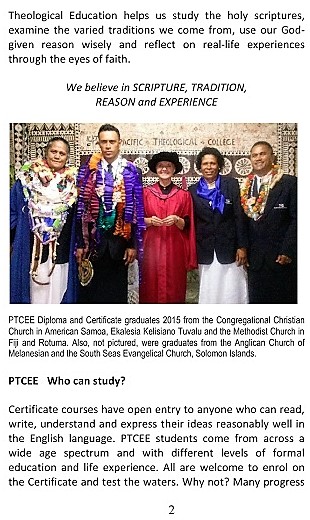
Orientation week for new arrivals at the main College. Nisha and I really enjoyed today meeting brothers in ministry from the Evangelical Lutheran Church in Papua New Guinea, Congregational Christian Church of Samoa and the Anglican Church of Melanesia in the Solomon Islands. Here we are, shamelessly 'selling' the Extension courses to them so they can transmit the good news to folk back home.


As it happens, we needn't have said much ourselves, because an enthusiastic ambassador for PTCEE was in our midst - little did we know - and gave a fantastic testimony. As a layman, he completed Certificate and Diploma courses up until 2006, recognising with appreciation the efforts and encouragement of PTCEE Director Deidre Madden at that time, then the call to full-time ministry came. He did his BA residentially at Bishop Patteson Theological College Kohimarama, just outside Honiara, and has been serving as an Anglican Priest in the Solomon Islands since. Now there's the opportunity to pursue a Masters here on campus at PTC. 

Fr Harry Gereniu kindly posed with Nisha by our map of the Solomons and spoke with great warmth. 'After all these years it's wonderful to be in the place where all these courses actually come from. I feel proud to have done my early theological education through PTCEE and thoroughly recommend it'. 


Thanks Fr Harry. You made our day and we thank God for your powerful testimony. Good that we'll be neighbours for the next couple of years and can draw on your solid experience of the agonies and ecstasies of Distance Ed! 

Introduction to the Study of John, James and Revelation is the latest BD course on the shelf ready to go. We thank Biblical scholar Dr Michael Sandford for his work. I fiddled with the edit and Nisha made it neat and tidy. Always a good feeling to sign off another one. Let's keep 'em rolling.


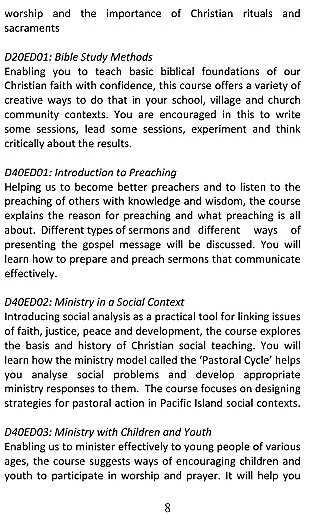
We also updated our College Handbook section. I wondered if this was a bit boring for the blog, but you can always skip it. It is, however, the bright, shiny, up to date summary of what's offered and how it's delivered from the office-at-the-corner-by-the-sea to - we hope - an ever wider, ecumenical spread of God's people across Oceania. Can you whisper the good news too? We can't leave it all to Fr Harry...


Theology for All for Life. You know you need it.