Saturday, 26 May 2018

Bugles in Heaven

Some grieving over here, combined with massive gratitude. It's been a week of lively and poignant communications with friends and contacts in the light of this news.


Methodist Church announce Rev Dr Colin Morris' death
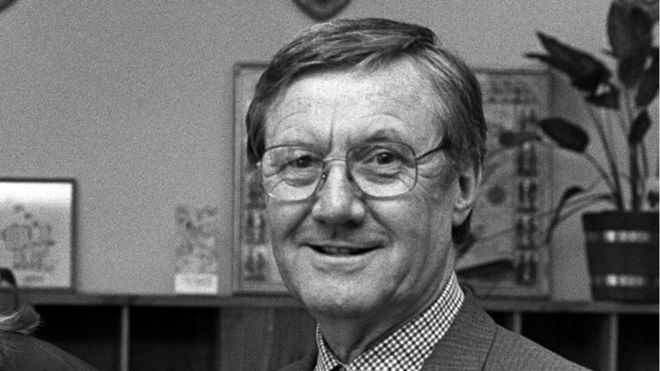

BBC Northern Ireland controller Rev Dr Colin M Morris in 1989

Preacher, author and broadcaster Rev Dr Colin Morris has died.
The past president of the Methodist Conference was head of religious broadcasting and controller of BBC Northern Ireland from 1987 to 1991.
He served as a missionary in Zambia and was elected as the first President of the United Church of Zambia.
The Rev Canon Gareth J Powell, Secretary of the Methodist Conference, said he was "one of the most effective and thoughtful communicators".

Outspoken

The Rev Dr Morris, who was born in Bolton, became known for his passionate and outspoken views on political and social issues.
He became a close friend of President Kenneth Kaunda, with whom he worked  during negotiations for Zambia's independence.
"In Colin, Methodism was faithfully and passionately represented but more than that - the gospel was proclaimed with integrity," added Rev Powell.
"He took the task seriously, was alert to the contexts in which he served, and above all he waited on God."

Sandy, Colin's wife, their immediate loved ones and all those who'll be closely involved in funeral and farewell gatherings are being firmly held in prayer here, far across the waters. And why wouldn't we? Colin headed up the British Methodist Church's Overseas Division for some memorable years during his ministry. His correspondence archive contains letters from the Methodist Church in Fiji. He was a prophet of many parts.

He was also my PhD subject. An unwilling one, self-confessed. 'I can't think why you're bothering', he used to say wryly, in the no-nonsense Lancashire tones that never left him, while handing me another carton of 'treasures' - unpublished manuscripts in various stages of completion, correspondence, newspaper clippings, cassette tapes, sermon skeletons, lectures, speeches and scribblings. These were logged and filed during the research - about 1000 items up to 2013 - and deposited at the Oxford Centre for Methodism and Church History with his knowledge and extraordinarily kind permission. There simply aren't words sufficient to  express my gratitude to him for this generosity.

The reason I bothered is below: expressed as well as I was able, in order to justify both conviction about the subject/project alongside sufficient, rigorous academic detachment. Colin would have been teasingly scathing about that sort of establishment requirement, considering it rather po-faced and pretentious. I knew just what he meant, but produced the goods anyhow rather than put the whole thing in jeopardy. It just meant sharing part of my Christian testimony basically, in the kind of way that wouldn't cause a PhD examiner to wrinkle their nose and tut too much. Here it is.

3.3.2   Looking Within

My personal interest in Colin Morris’s life and work needs to be declared. It is not detrimental to academic detachment: it rather represents a small background section in the jigsaw. There is nothing dramatically colourful that should grab attention but, like an indefinable piece of blue sky or green grass, it must be given its place in the totality of this project. 

In 1976, at the age of sixteen, I was confirmed at Plymouth Grove Methodist Church, Manchester. This rite of passage marked a serious personal commitment to the Christian faith. It was the year of Colin Morris’s Presidency of the Methodist Conference and his influence was everywhere. Northern, working class Methodism of which I was a part revered him, not least because of his Bolton roots. My own father, a committed, cradle Methodist with a living faith died suddenly two years later at the age of fifty-four. He had spoken frequently about Colin Morris and admired tremendously his preaching and principles. I respected my father and absorbed much from this. I read Include me Out! with its poignant story of the starving Zambian found dead on Morris’s doorstep, while I was in my teens and about to embark on a first theological degree in Manchester. Because of it, I wanted to change the world. I began by training to be a Methodist local (lay) preacher. How else? 

Vocationally and professionally since that period, my background has been in radio broadcasting, as a minister in the Methodist Church here in Britain - but ordained in the United Church of Zambia where I served on the Copperbelt from 1993-1998 - teaching in the field of global mission education at the Selly Oak Colleges and the Queen’s Foundation in Birmingham (2000-2009), and regularly preaching, speaking and broadcasting. There is no comparison whatsoever intended between the magnificent breadth, substance and reach of Dr Morris’s work and my own. To suggest so would be as ludicrous as it would be embarrassing. I am simply fascinated by the autobiographical points of connection: vocational, professional and geographical; entirely unplanned. 

3.3.3 Looking in totality 

In summary then, this study embraces and is energised by Creswell’s support of the biographical or life history approach to qualitative research and has applied his criteria to make a justifiable case. There is sufficient literature by or related to Morris who more than fulfils the requirement that the research subject should be ‘someone who has had a distinguished career, someone in the national spotlight…’  Accessible and available material about the subject from historical or present day sources Creswell sees as essential, and this is exactly what the Morris database affords. Drawing heavily on Denzin’s interpretive biography, Creswell’s four challenges for the interpretive biographer are regard as baseline principles for this study: the collection of extensive subject-related materials; the positioning of the subject historically and contextually within the larger trends in society or culture; the necessity of reading the life as a multi-layered phenomenon; and the writer-researcher being able to acknowledge her standpoint in the narrative.

Brinkmann, writing on the use of everyday life materials in interpretative qualitative research, is keen that researchers build on questions and problems that are of genuine interest to themselves. The Colin Morris Collection’s materials are somehow ‘everyday’ and unusual in equal measure, and my particular interest is in what they reveal about one human life-script which has been consistently able to traverse different territories and make radical, vocal impact. Or, how one ‘voice’ has managed to communicate its messages transcriptively into and out of many audiences and across competing cultures. The key to unlocking that question in the thesis is activated by conscious, radical, looking, listening, reading and questioning throughout. 

Colin, communicator par excellence, inspired me to road test a bit of new vocabulary. That was one of the things that caused mild examiner tutting and nose-wrinkling. I tried to put forward the case that he was able to communicate, with consummate skill, transcriptively; ie. across hugely varied scripts and spaces, and in doing so, brought a wealth of theory and resource to communicators within the Church and without. In the 'transcriptive space' of Colin's communications, scripts intertwine and interact, themes emerge, are reworked and reemerge, and the whole marketplace or dancefloor of scripts is wonderfully energetic and mutually creative. That was the gist, anyhow.

And now, since being in Fiji, it's been absolutely fascinating to reflect even more about  this notion, enriched by precious, intricate, indigenous Pacific understandings of communication, under the umbrella term talanoa. What I understand of talanoa is a miniscule drop in the vast ocean, but out of initial musings, and much encouraged by Pacific colleagues, transcriptive space met talanoa in this Conference article. I share it for your interest below, but primarily as a personal tribute to Colin. It wouldn't have happened without him. 

Neither would a whole lot of other things that have made the world a better place.

Bless you, Colin. Thank you, Lord. 


Here's that Conference article I mentioned. Should I have taken the carving knife to it?

Transcriptive Space meets Talanoa

A paper presented to the 14th Assembly of the International Association for Mission Studies. 11-17 August 2016, Seoul.

In the Education by Extension (Distance Learning) Department at the Pacific Theological College, we are often asked by students for a certified copy of their transcript. A transcript details someone’s educational achievement. We click the button on a departmental database and usually - because sometimes the spirit blows where it will in Microsoft Access - a neat summary of courses and credits appears. An accurate transcript is a precious piece of communication. It is much more than documentation. It can speak volumes: not least to the one who earned it; the human being, the very mind and heart, flesh and blood whose sweat and toil brought forth the words and got the grades. So precious is this unique piece of student communication that many universities are keen to boast about their watertight transcript stationery: a secure and personalised hologram, controlled watermarked paper, innovative and highly secure ink, verifiable numbering matrices and security infilling. Nobody messes with our transcripts, is the stern message.

The prefix ‘trans’ before ‘script’ is useful. It suggests a script that can move: not a piece of stationery that is stationary. It refers, in the academic sense of course, to the summary of achievement across a spectrum of learning. Someone has navigated their canoe through oceans of learning. ‘Well done!’ we say. Here’s a flag to nail proudly to your mast. But that flag-transcript, flying high, will inevitably catch the breeze and face the elements if the person’s voyage of discovery continues. Unchartered waters beckon; choppy seas, maybe. That flag-transcript can be raised aloft for sure: as a formal record of learning, it should not be tampered with. But for it to be any use in practical mission, the formal script cannot stay forever in the safe harbour of the issuing University and the student’s ornamental photo frame. The transcript needs to become powerfully transcriptive; credited learning able to live again and communicate afresh across multiple places and spaces. 

In recent years, I have researched the mission and ministry of someone who, I humbly propose, has operated transcriptively. (Ogden 2014). The Revd Dr Colin Morris, now in his eighties, permitted me within his own lifetime, and with breathtaking generosity, to scrutinise a huge range of published and unpublished documents and scripts emerging from his life of multiple identities and contexts. The Colin Morris Collection comprises about 1000 items, now held as a hard-copy collection in the Oxford Centre for Methodism and Church History.[1]

Allow me to introduce Dr Morris briefly, though briefly is hardly sufficient. Colin Morris was a Methodist ‘boy preacher’ in the 1930s, in the North of England. His family were from Salvation Army and Primitive Methodists roots. His father was a coal miner. They were down to earth, working class people. It was soon discovered that Colin Morris was a gifted communicator and could enthral a crowd as he preached in the open air, at a very young age. Much later, this communicator’s gifts in political and pulpit oratory led him into the British Methodist ministry and the mission field of Northern Rhodesia, later Zambia. His high profile role in the country’s freedom struggle, its movement towards Independence in 1964, his friendship with Dr Kenneth Kaunda and his own presidency of the newly formed United Church of Zambia are reasonably well documented, though in popular (Charlton 1968) not academic forms (Laird 1980). [2] Returning to England in 1970, he became Superintendent of Wesley’s Chapel, popularly known as the ‘Cathedral of Methodism’, in City Road, London, until his appointment in 1973 as General Secretary of the newly branded Methodist Church Overseas Division, previously the Methodist Missionary Society (Pritchard 2014:43). Inevitably, British Methodists were to choose him as their church’s president for a memorable and highly publicised one year term 1976-77. In 1978 Colin Morris joined the British Broadcasting Corporation as Head of Religious Television and was then, successively, Head of Religious Broadcasting and BBC Controller, Northern Ireland. Morris retired from the BBC in 1991 and until 1996 was Director of the Centre for Religious Communication in Oxford. He continues to write and reflect on major themes: mission, media, politics, prophecy, ethics and communications would be frequent favourites.

The territories of operation for Dr Morris have included the pulpit under fire, the radical political platform, the mission field, the global mission desk, the minister’s study, the broadcast studio and the busy newsroom. I contend that Morris operates most effectively in the transcriptive space these territories spawn as scripts converse, collide, intersect and reemerge. The broadcaster within Morris constantly dialogues with the preacher, the author within him converses with the lecturer and so on and so forth. Transcriptive space – a term I have coined - is of essence non-geographic: there is no locatable temple, no abiding city in which to dwell comfortably and permanently. It is communicative space where diverse yet related scripts converse. 

The point of this paper, emerging with immense gratitude from Morris’s work, is to offer the notion of transcriptive space, if useful, as a working tool for mission thinking and practice. It may not be. Of particular interest to me at present, understandably, are the faith and life ‘trans-scripts’ of my current context, the Pacific Theological College in Fiji, where Tuvalu meets Samoa; West Papua meets Kiribati; home islander meets distanced diaspora; mainstream church meets new religious movement and residential education meets distance learning. Converting and transforming encounters abound in the transcriptive space that is PTC. This may be when the received script of biblical literalism meets the current literature on climate change, for example, or when ordained women from one Pacific mainstream denomination encounter sisters from another Pacific mainstream denomination unable to pursue ordination because their denominational script; culturally, historically and ecclesiologically, has emerged differently. Just two examples of many.

When the transcriptive space notion travelled with me to a new life in Fiji in 2014, I wondered what might become of it, if anything? How God might use it, if at all? Almost immediately I found myself bathing in rippling tides of talanoa: the Pacific communicative concept and space common to many contexts. As a well-disciplined mission partner, I’d read a little about talanoa previously in the course of teaching mission studies and in preparation for the new ministry.[3] But when you’re in London, on the top deck of the bus, reading about talanoa as the icy-cold rain beats against the window and you shiver; it’s a world away from Suva, seated in community space, on precious woven mats, inhaling the sun-blessed fragrance of earth and ocean, engaging in talanoa. 

A tidy talanoa definition is almost impossible to pin down, but Jione Havea has written expansively on this theme.

Talanoa is a word used in several of the native languages in Oceania (also known as Pacific Islands) to refer to three interconnected events: story, act of telling (of memories, stories, longings and more), and occasion of conversation (teasingly and critically and usually informally). Talanoa is more than one or two of these, for talanoa is all three events – story, telling, conversation – together. Talanoa is a point of intersection, like a passage in a reef, through which currents and waves whirl with the rising and receding tides. (Havea 2010:11)

Talanoa as a point of intersection. Where whirling currents and waves meet. What a powerful Pacific optic impelling me to look again at so many aspects of Colin Morris’s ministry and mission. In the 1950s, for example, the scripts of Northern Rhodesia’s freedom campaigners intersected with Morris’s in such a profound way that they revolutionised the biblical exegesis and application that had previously informed his preaching, completely rewriting the scripts (Morris 1961:32-33). These were waves of change indeed. It was through life-changing talanoa – never called that of course – with passionate, articulate, black African leaders of the time: Sokota Wina, Godwin Lewanika, Lawrence Katilungu and, definitively, Kenneth Kaunda that Morris’s life scripts were transformed and transcribed (Kaunda/Morris 1980).[4] The vastness and complexity of all Morris had previously been exposed to and schooled in through Western philosophy, anthropology, theology and political science: the myriad words and ideas, took on flesh with intelligibility, simplicity and dignity in the form of those with whom he sat, ate, wrote and debated.

What else in these oh-so-tentative early explorations of talanoa and transcriptive space? Karlo Mila-Schaaf, writing on social work practice, draws on the Samoan socio-spatial concept of vä with reference to a number of Pacific thinkers. Vä, it seems, has room for both speech and space. She writes,

If we imagine that you and I are positioned on a map, vä is used to describe the nature of the terrain that lies between us. It is the ‘imagined’ space that we ‘feel’ as opposed to see. Ka’ili writes that: ‘Vä emphasises space in between. This is fundamentally different from the popular western notion of space as an expanse or an open area’ (Ka’ili, 2005: 89). As Albert Wendt writes, the vä is: ‘Not space that separates but space that relates’ (Wendt, cited in Refiti, 2002: 209). One can imagine or visualise the gardens and boundaries between people. Either they are tended and fruitful, or they are barren and unsafe. (Mila-Schaaf 2006:1)

In conversation with the Samoan concept of vä, transcriptive space is both focussed and enlivened. Perhaps, seen this way, it is less a performance stage on which competing players with their scripts jostle to be in the spotlight and more relational ground which allows for breathing space and transformational exchange. The terrain between our human life-scripts and that of others is perhaps not so vast after all, and not necessarily oppositional. Transaction and transcription for mutual benefit are possible. Colin Morris political campaigner and Colin Morris pulpit preacher can dig the same soil as they tend carefully the space in-between their scripts, anticipating new shoots and a mouth-watering harvest.

These Pacific-inspired thoughts are as yet few, and without polish. I have much to learn. Exposure at IAMS will refine them and help them to shine a little brighter. Thank you. [5]


Bibliography and references
Charlton, Leslie (1969). Spark in the Stubble. London: Epworth Press.
Havea, Jione (2010). Talanoa ripples: Across borders, cultures, disciplines. Pasifika@ Massey.
Laird, Doris., ‘Colin Morris, Modern Missionary.’ PhD diss., Florida State University College of Arts and Sciences, 1980.
Lilomaiava-Doktor, Sa'iliemanu. "Beyond" migration": Samoan population movement (Malaga) and the geography of social space (Vā)." The Contemporary Pacific (2009): 1-32.
Mila-Schaaf, Karlo. "Va-centred social work: Possibilities for a Pacific approach to social work practice." Social Work Review 18, no. 1 (2006): 8.
Morris, Colin (1961) The Hour After Midnight. London: Longmans.
Morris, Colin., ed (1980) Kaunda on Violence. London: Collins.
             Ogden, Valerie., ‘Information made Intimate.’ PhD diss. Spurgeon’s College/University of Wales. 2014
Accessed 20 May 2016

Pritchard, John (2014). Methodists and their Missionary Societies. Farnham: Ashgate
Refiti, A. (2002). Making Spaces: Polynesian Architecture in Aotearoa/ New Zealand. In S. Mallon and P.F. Pereira (Eds.). Pacific Art Niu Sila: The Pacific Dimension of Contemporary New Zealand Arts. Te Papa Press: Wellington: 209-225

             [2] With the exception of Doris Laird’s 1980 unpublished doctoral thesis, ‘Colin Morris, Modern Missionary’ covering the Northern Rhodesia-Zambia years only, and which I critique in Ogden, Valerie ‘Information made Intimate.’ 172-178.
[3] Discovering that there is an ever expanding contemporary and critical talanoa literature, not least in the area of academic research methodology. See for example, Fa‘avae, David, Alison Jones, and Linitā Manu‘atu. "Talanoa ‘i ‘ae Talanoa—Talking about Talanoa: Some dilemmas of a novice researcher." AlterNative: An International Journal of Indigenous Peoples 12, no. 2 (2016) and Vaioleti, Timote. "Talanoa: Differentiating the talanoa research methodology from phenomenology, narrative, Kaupapa Maori and feminist methodologies."Te Reo 56 (2013): 191.
[4] See the preface to Kaunda on Violence (London: Collins, 1980).
[5] I express sincere thanks also for the conversations and colleagueship of our Oceanic and increasingly global faculty and learning community at the Pacific Theological College, Suva. www.ptc.ac.fj. You have in many ways fed this paper and its musings. I am wholly responsible for its inadequacies. Vinaka vakalevu. Tenkyu tumas. Fa’afetai tele lava.

Thursday, 17 May 2018

Cheerful and not quite so cheerful

Coming up to four years in the Pacific. Still lacking in so many skills.


We were missing the good company of Keleni who's often at our informal Friday tutorials. Was she working on Fridays now? Did anyone know? Committed elsewhere? Was she OK? Yes, as it turns out. Very OK busy being a new grandma to this one . Aww...


A great joy and honour to have been invited to Rosie's graduation. Here she is!


A faithful youth group member from our Nanuku Church. She earned a Fiji Certificate I in Cookery from the Technology College of Fiji and it was great to be part of the huge, happy crowd at our local stadium witnessing certificates being presented for all sorts of practical skills: motor mechanics, painting and decorating, carpentry and the like. 


The Fiji First government is big on vocational qualifications and Hon Jone Usmate our Employment minister pictured below, was the Chief Guest. Soundbites from his speech included:

Fiji needs people who don't run away from science, technology and maths. The greatest constant in life is that there will always be change.

We need to focus on green technology. Mechanics, learn about hybrid vehicles. Agriculturalists, learn about organic farming. You have achieved something really great, but it doesn't stop here.

We must address presenteeism more than absenteeism. People are present at work but not able to function fully. We are not as well as we need to be.


Here we are with Mum Shelley who supported her girl through some very challenging times indeed on the journey and found the resources and energy as all the best mothers too. She deserves a few Certificates too!


Ah yes, and there's been a significant absentee in the Extension Education department for the past three weeks, thanks to a freak domestic accident. A floorboard, wood weakened and rotting because of the recent Nadi town floods, decided to give way dramatically under our beloved administrator Nisha on a visit to her parents. Memories of a blood-curdling scream and a crash still bring her partner out in a cold sweat. 

Unhappy result? One fractured left knee, now with plates in it post-surgery. One fractured right heel, healing by itself, so the orthopaedic people say. No weight bearing possible on either for 10 weeks. So, there's been a bit of a flurry of covering admin work, hospital visitations, sorting out a wheelchair and we'll be having ramps up to the department put in place next week. It doesn't half make you reassess disability access at PTC. Frankly, we could do better.

Dear, dear Nisha. Everyone really misses you and we're in pain-bearing solidarity as much as we can be. We know you're perfectly OK waist upwards (so to speak!), can't wait to be back at work - God love you - and we can't wait to have you back. #AdminOnWheels. #ExtensionMobility. #MercedesBenz

From everyone at PTC and all the blog readers - a million prayers and a big Get Well Sooooooon!!


Saturday, 28 April 2018

Love in truth and action

Glad to be able to share a recent Chapel sermon, with the kind permission of the preacher Rev Ioutua Tutairi from Maohi Nui [Tahiti]. I loved the opening and that it conveyed deep things with deceptive simplicity. Click the arrow and it'll pop out for you. #popoutpreaching. 

Enjoy!

Friday, 20 April 2018

New seeds in the garden

PTC held an induction service for our three new Faculty last evening: Dr Faafetai Aiava, Lecturer in Theology & Ethics; Dr Fetaomi Tapu - Qiliho, Lecturer in Academic Skills & English and Mr Sanjeet Pratap Singh, Director of Finance & Administration. They're not 'new' in the sense of not known to the community. They've been colleagues for quite a while now in various capacities. But new in the sense of being formally welcomed into their designated areas of service. A Chapel service was held and then followed by the traditional sevusevu ceremony of welcome. A few snapshots below for you and, if you're a praying type, please keep Faafetai, Taomi and Sanjeet firmly in your prayers. It's not 'a walk in the park', as they say, at PTC, and certainly not if you're at the finance desk...


Faafetai, Luse and the children - proud of Dad!


Sanjeet and Fetaomi


Induction promises, presided over by Bishop Api, Vice-Chair of PTC Council


Post-induction smiles!


Welcome ceremony from the Fijian ethnic group

It's so, so encouraging that, little by little, new BD courses are being polished off for delivery by Extension - now online as well as in print. I've often posted with gratitude about these as they become available. The latest course, written by our much valued Faculty colleague Revd Dr Donald Samuel, has gone the extra mile in that he produced not only the course book but a brand new, original, 323 page textbook. Wonderful! The BD Course is 'Foundations of Christian Education' and the book ...


The cover picture was hand drawn by Donald and Jaya Christi's son Dr Kgolagano Mahizh Samuel. 

Although it acts as a textbook for our BD course, it's available in its own right from the PTC Bookshop bkshop@ptc.ac.fj or via Dr Donald Donald.Samuel@ptc.ac.fj if you're interested in following through. 

Dr Donald's work manages to be both an in-depth textbook, with challenging concepts and terminology to work at, and yet pictorial and narrative simultaneously. There are many snippets and paragraphs that catch the eye and connect the soul. I liked this one, for example, from page 65.

Christian Education in the Pacific and beyond today may be compared to God's garden where we find the learning process similar to the organic growth of plants. Christian education leaders are like gardeners and the learners are like plants that have innate potential to grow. Yet God has implanted in each of us the seeds of learning; we are all in the process of development. Hence we, both as 'leaders' or 'educators' and the 'participants' or 'learners' are all learners as well as gardeners to one another. 

I read that and a little voice in my head started to sing, from the old Methodist Sunday School hymn book I grew up with a few centuries ago..


My childhood, mental image of being a tiny be-petalled floweret, face uplifted and beaming in the sunshine, as Jesus the gardener walked along the rows like Percy Thrower (remember him?) with his metal watering can, to give me a drink, is very vivid. And now Dr Donald revives that image for adult Christian educators. How can we best be one another's gardeners: digging our neighbour's soil so that their faith can flourish?


I wrote the foreword to Building Up the Body of Christ at Dr Donald's kind request and was humbled to be asked. Here it is.


Only a seasoned practitioner should aim to write a specialist textbook in Christian Education. Fortunately for the reader, Revd Dr Donald Samuel is such a person. With vast experience of exercising mission and ministry in diverse contexts: India, Norway, Botswana and American Samoa to name but four, the author has woven a fine mat of multiple, vital strands in compiling this work. Samuel, as might be expected, references the work of scholars from the global North who would be traditionally revered in this field such as Groome and Westerhoff. Friere’s massive contribution to pedagogy is also respectfully and predictably acknowledged. But the author is primarily interested in celebrating the kind of Christian Education which owes its source not to conventional schooling and scholarship but to the God of Life. His premise is that faith formation and nurture spring naturally from the One who imbues all creation and humanity with everything that is necessary for wisdom and growth into fullness of life, if only we would open ears, eyes and hearts to receive it. Samuel is critical of Christian Education relegated to classroom practice and predictable teaching methods adopted from colonial models. These stifle and suppress, he argues. Creation, community, family and relationships are the authentic ‘classrooms’ of Christian Education if it is to speak powerfully to daily life in tangible contexts. Whether the aim is Biblical teaching, liturgical training, pastoral caregiving, whatever; methodologies must emerge naturally from the land, sea, sky and soil of the particular context if they are to work. An authentic, Christ-like life, if appropriately ‘educated’ through such methods, will pulsate with Holy Spirit-filled Indian-ness, European-ness, African-ness, Pacific-ness. And God, through Christ, will be glorified. Samuel does not write of these things, however, as though in a detached fantasy land. The subjects and effects of rapid development, technology and globalisation on Church, family and society are often tackled. But he is never despairing; ever keen on ‘pursuing goals that are vital and related to larger purposes of God’s Reign and justice’. (p??) This is a detailed, scholarly work, comprehensive and attentive to the history of Christian Education as an academic discipline in practical theology, with knowledge of the literature and concepts that have been born out of that. It amply does the work of a textbook in the field. But more than that, the author’s heart for conventional Christian Education’s urgent, contextual revival, in hugely changing times, leaps from every page. It is the offering of a practitioner and visionary.

The Revd Dr Val Ogden
Director: Pacific Theological College, Education by Extension.

1 August 2017

And talking of flowers. Here are the Chapel arrangements prepared by Ete and the Women's Fellowship this week.


Not fresh - but a fresh idea.
The reverential recycling of those painful polystyrene cups! 

Some people are just too talented...

Sunday, 8 April 2018

They only ever talk about the weather...


A week and a day on from Easter Sunday and I'm 'working from home' on campus. Torch, matches and candle at the ready for power failure and water bottles filled. The fragrant Xmas candle doing long service proclaims 'Festive Cheer' but I'm not entirely sure about that. PTC closed at 1pm for today and tomorrow because Tropical Cyclone Keni may be on the way and, as already illustrated in the previous post, there's extremely heavy rain and flooding across swathes of the land. Fiji's schools and universities are closed. TV, radio and social media full of images and warnings.

Nadi, the town of our international airport and the main hub for travel to tourist destinations has taken a bad hit. This isn't a new thing: people remember horrendous floods in 2009 and others with alarming regularity over the years since. But when Nadi gets it, the climate change and disaster management conversations turn once again to tourism and the part it possibly plays in all of this.

Come with me for a moment to Denarau Island. As Fiji Tourism describes it...


Attached to the mainland by a short causeway, Denarau is the place to be pampered. Less than 10km from Nadi, Denarau boasts eight large resorts, stunning beaches and an 18-hole championship golf course. Luxury suites, sparkling swimming pools, world-class cuisine, shopping and adventure options – Denarau has it all.

Note if you would that key piece of information, 'less than 10 km from Nadi'. 

I've only been to Denarau once, and that was up and down in a day to give a lecture about use and abuse of the Bible to prison officers from across the Pacific. They were meeting in the glitzy Sofitel. It's good that Fiji can host huge conferences like that in top class surroundings, isn't it? It's fine for Fiji to maximise all the 'benefits' that conference, tourist and visitor hospitality can bring to the economy. 

And yet....  While prison officers - in that instance - receive the very best in top notch facilities as guests at a glamorous hotel, Nadi's residents are increasingly prisoners in their own town as, with frightening regularity, waters swell, streets flood, bridges collapse and small family businesses go under. And it's worse since the coming of Denarau, some would say.

Now I'm not sufficiently schooled in the fields of climate change and disaster management to be touting a particular line here. But I've become interested in the Denarau factor and the Nadi floods over recent years. So I thought of sharing just a few observations from a 2013 research paper: Tourism Investment Choices and Flood Risk: illustrative case study on Denarau Island Resort in Fiji by Karen Bernard, United Nations Development Programme and Samantha Cook Secretariat of the Pacific Community It's in the public domain and clicking on the link above will mean you can read it in full for yourself, if you wish. They also have a helpful bibliography to other sources.

Just to say, I don't know these authors and nor do I make any claims for this being the top example of the literature surveying the topic. I simply found it helpful because it sets out some background and stats very plainly: the kind of 'academic' paper with content that fleshes out the 'ordinary' conversations all around us.

So I'll just share some extracts, with every credit to the authors cited above. SIDS, by the way, stands for Small Island Developing States. [In a different context it might be Sudden Infant Death Syndrome]. The questions included as subheadings are my only contribution.

So... how many tourists actually come to Fiji?

Tourism arrivals have increased by 115 percent between 1999 and 2010, reaching 631,838 in 2010 (Fiji Islands Bureau of Statistics - FIBOS) - a number almost equal to the entire population of Fiji, at 883,125. There was, however, a marked decline in 2000 following the coup d’état and also in in 2009 following the Nadi and Ba floods. Fiji attracts tourists from all over the world, each year on average 75 per cent of visitor arrivals are tourists equating to some 472,634 tourists who spend, on average, 9.2 days in country. 

And they come in from where?

The majority of visitors come from Australia (46%), followed by New Zealand (17%), accounting for 63 per cent of visitors. A further 10 percent come from the US and another 10 percent from Europe, the remainder originating from Asia and the rest of the world. In addition to those tourists coming on vacation, Fiji receives regular visits from cruise ships in to Suva, Lautoka and Denarau. This sees an additional 60,301 people arrive in the Fiji islands for a day trip (FIBOS). Today, 50% of the tourist arrivals in Fiji go to Denarau, many of them traveling out to the Yasawas island chain via the marina. 

Interesting. Half of Fiji's tourists go to Denarau. What does that name mean, actually?

The name "Denarau" is a shortened version of the Fijian phrase dede na raurau, which in the Nadi dialect of Fijian language translates loosely as “rubbish piling up.” Before it was developed into a tourist enclave, much of the land area in what is now Denarau was comprised of mangroves, swamps, low-lying small islands and mud flats. When floods occurred, currents routinely transported a concentration of debris and rubbish into this area, leading to the use of this phrase to refer to that spot. 

What's the commercial background to the development?

The Denarau concept was elaborated in a Master Plan outlined by an American developer in 1969. The first luxury hotel was built in 1975 (the Regent, which is now the Westin), followed by the Sheraton in 1987, and in the 1990s, a cascade of five-star accommodations including Hilton, Radisson, and Sofitel. The most accelerated development push in Denarau occurred from 1988-1993, when Japanese property developer EIE International Corporation entered the scene and undertook “major development works on the island of a scale never before seen in Fiji. This included the clearing of the balance of the 600 acres of land, the reclamation of a vast area of swamp… and $100 million (USD) spent on infrastructure.” (Tabua Investments, 2012). As de rigeur with such exclusive areas, the island resort includes a world class golf course, shopping malls, tennis courts and a bustling marina teeming with cruise ships and yachts. 

There must have been tempting investor benefits, right?

To promote the rapid expansion of this upscale tourist enclave, major international hotel chains were offered an attractive package of incentives, including tax-free status for 20 years. The rental cost of the land lease was lowered after negotiations with the Tui Nadi (chief of Nadi), taking into account the economic benefits foreseen for the local population of the anticipated tourism boom.

And what about that investment incentive that they call a SLIP?

To promote significant tourism investment, in 1996 Fiji introduced a Short Life Investment Package (SLIP) for investments of over $40 million FJD, and later the HALF SLIP for investments of $7 million FJD or more (FIRCA 2012). Clearly this considerable level of investment is accessible only to multinational companies and hotel chains. Under the SLIP, exemptions and incentives are generous, consisting of: 20-year tax holiday on the investment, duty free status on capital equipment and the importation of construction materials, as well as exemption from sales tax (VAT). For the Half SLIP these same exemptions apply for 10 years. 

What was there before Denarau?

The Denarau project spans 680 acres and entailed significant construction on a foundation of reclaimed land, taking space previously occupied by the ocean and filling this in to form a land mass through trucking in soil from the upper Nadi River basin and pouring concrete. From the nearby village of Ratabu, 2.5 million cubic meters of soil were brought in, demolishing an entire hill from that area. The coastline in this part of the country featured an abundance of mangroves, which act as a very effective natural buffer against incoming waves and provide protection against erosion, storm surge and even tsunamis. 

So those mangroves are much missed...

Many of those mangroves were old growth trees of more than 100 years, with extensive and sturdy roots. For the construction of Denarau, much of this mangrove area was removed, as these plants interfered with tourists’ access to the sea and did not mesh with the new vision of a highly manicured landscape. The Denarau brand logo features two herons, one sitting and the other poised for flight – to symbolize relaxation and activity. This reference is more historical than contemporary; with the elimination of large expanses of mangroves, herons are no longer seen in this area.

Hasn't flooding always been part of Nadi life and always will be?

The Nadi-Ba catchment area, inside which Denarau is located, has always been notoriously flood-prone, but in the last 5 years the incidence of severe floods has increased remarkably. This may be considered partially an effect of climate change, but the Denarau development can also be considered a key aggravating factor increasing flood exposure. Flooding at a level considered a 1-in-50 year event (Hay, 12 2009) occurred in this zone in 2009 and again in 2012. In 2009 an assessment conducted by the Prime Minister’s Office estimated damages due to the 2009 floods at $60 million USD, amounting to 3 percent of GDP. A total of 11,458 people were displaced and 146,725 affected (17 percent of the population) in significant ways, mainly sugar cane farmers, other farmers, small business owners and self-employed market vendors (Government of Fiji, 2009).

And surely Denarau itself suffers too, being so close to Nadi?

...even during the severe flooding recently occurring in Nadi, or during heavy cyclones, the Denarau enclave never floods. Due to the exquisite planning and engineering with which it was built, with land elevated by 2 metres and highly efficient drainage channels, it suffers only minimal damage created by high tides causing salt water inundation. However, the Nadi central business district was submerged in up to 4 metres of water during these floods, effectively blocking tourists’ access to the airport and blocking delivery of supplies to the hotels. Following the March 2012 floods, some tourists were transported to the airport by helicopter at a cost of $300 USD each, while in some locations others were delivered by boat to the airport


So what does your research conclude? What challenges have got to be faced in the light of it?

1. SIDS countries often face difficult choices on which paths to pursue towards development and the dream of prosperity. While tourism often seems a logical and profitable choice, under which SIDS can capitalize on their natural attractions, investment in this sector must be chosen and assessed carefully. 

2. In the tourism sector as in others, there are a range of options on different scales, and business models which have implications related to environmental and disaster risks. It is imperative that national governments attempt to anticipate and weigh the long term implications of these different options in regard to disaster risks – to determine whether they may be neutral or increase the risks of disaster impacts. 

3. Some of the dynamics noted in the Denarau case study include repatriation of a significant portion of the profits, and urban drift to more vulnerable sites (Nadi river basin) as people seek to seize the opportunities expected with the tourism expansion. It should be noted that tourism is a luxury item and when there is an economic downturn, as was the case following the global financial crisis, people either travel less or stay closer to home. 

4. Similarly, investors choose to reduce their net foreign assets in preference for domestic assets. These dynamics in fact increase vulnerability, which is ultimately transferred to the small business owners, hotel employees and local residents on the fringes of the land which has undergone major re-engineering to accommodate international hotel chains. 

5. All parties concur that the flooding in Nadi is expected to worsen, and some observers anticipate that Nadi town and the adjacent townships will be under water by 2030, based on extrapolation of the current trends (Buimaiono, Solomoni, 2012. 'Nadi underwater by 2030'. The Fiji Times. Suva, Fiji. 15 June 2012)


6. Under that extreme but lamentably likely scenario, international investors will be quick to cut their losses and close down operations in favor of the next island with pristine sandy beaches. The Fijian population, especially those with the fewer resources, will then be left to fend for themselves in the face of rising waters.


http://www.fijitimes.com/gallery.aspx?gallery=1644

Bula Vinaka to all our members,
Due to the Cyclone warning, the Head Office will be closed tomorrow(10/04/18) and will resume on Wednesday(11/04/18).
Lets pray for God's protection and guidance in this time and we encourage all members to take heed of all warnings and precautionary measures.

We reaffirm the commitment of the church in offering its churches and church halls to be used as evacuation centers and to our members always be willing to lend a helping hand to others.