Saturday, 30 May 2015

Trinity Sunday already?

And so the Church calendar rolls around so quickly - extraordinary. Last week on Pentecost Sunday I went to the Methodist Church at Nanuku settlement again and benefitted from the preaching of tri-lingual Deaconess Ruth Prakash. Here's Rosie preparing quietly for worship - and thinking about whether God's call on her life might be as a Methodist Deaconess too.


Rev James Bhagwan
A video project has taken up a bit of time lately. I did interviews with nine ministers currently at PTC, each from a different part of the Pacific, who reflected on some critical life and faith issues. So grateful to them for giving of their time in the midst of essay pressures and exam deadlines. I'll find a way of sharing the video at some point, but for now it's being shown at the Methodists for World Mission Conference at Swanwick in the UK 29 -31 May. Grateful too for post-production facilities and expertise c/o Rev James Bhagwan, Secretary of the Methodist Church in Fiji and Rotuma's Communications and Overseas Missions Department, along with Maravu and Sakaria, the camermen. What a fun team to work with! 

Video making apart, the Extension Dept. has been engaged in the usual round of signing up students, printing and posting out course materials, keeping track of student progress, encouraging the 'backsliders', offering the Friday tutorial and one-to-one support, and trying to get ahead with the writing and editing of the BD courses. Big push on this for the next three weeks while the main College has its 3 week break between Semesters 1 and 2. 

Faculty colleague Rev Dr Donald Samuel and his wife Jayachristi have their daughter Kagiso with them on campus now and it was good to have them 'round at House 12 for some food and fellowship. Both Mum and daughter have signed up for theology courses with us and Kagiso is hoping to study a combination of medicine and theology, having already completed her BSc. Coming from a Church of South India background, they've previously served in mission appointments in Botswana and American Samoa. Increasingly Faculty friends bring a whole new set of windows on the world and that's excellent. Here are Christi, Donald and Kagiso with the remains of the rice and a benign tropical punch....


And it was my turn on the Chapel rota for Holy Communion as we looked ahead to Trinity Sunday. It's always so uplifting to preach and preside in the Chapel here with the beautiful, harmonious singing of the community and the scents and breezes of the campus floating through the open doors. (Though before I over romanticise the scene, we've had more than a gentle breeze floating through of late as it's our Winter and distinctly gusty!)

I don't often blog sermons, but will do so below for a change. Threefold blessings and bye for now!


John 3.1-17

Now there was a Pharisee named Nicodemus, a leader of the Jews. He came to Jesus* by night and said to him, ‘Rabbi, we know that you are a teacher who has come from God; for no one can do these signs that you do apart from the presence of God.’ Jesus answered him, ‘Very truly, I tell you, no one can see the kingdom of God without being born from above.’* Nicodemus said to him, ‘How can anyone be born after having grown old? Can one enter a second time into the mother’s womb and be born?’ Jesus answered, ‘Very truly, I tell you, no one can enter the kingdom of God without being born of water and Spirit. What is born of the flesh is flesh, and what is born of the Spirit is spirit.* Do not be astonished that I said to you, “You* must be born from above.”* The wind* blows where it chooses, and you hear the sound of it, but you do not know where it comes from or where it goes. So it is with everyone who is born of the Spirit.’ Nicodemus said to him, ‘How can these things be?’ Jesus answered him, ‘Are you a teacher of Israel, and yet you do not understand these things? ‘Very truly, I tell you, we speak of what we know and testify to what we have seen; yet you do not receive our testimony. If I have told you about earthly things and you do not believe, how can you believe if I tell you about heavenly things? No one has ascended into heaven except the one who descended from heaven, the Son of Man. And just as Moses lifted up the serpent in the wilderness, so must the Son of Man be lifted up, that whoever believes in him may have eternal life. ‘For God so loved the world that he gave his only Son, so that everyone who believes in him may not perish but may have eternal life. ‘Indeed, God did not send the Son into the world to condemn the world, but in order that the world might be saved through him.


Nicodemus in Three Persons

A sermon preached by Rev Val Ogden at the Pacific Theological College, anticipating Trinity Sunday 2015.

Our Roman Catholic friends are very sensible about Trinity Sunday. In their lectionary this year they read the Gospel of Matthew 28. 16-20. ‘Go therefore and make disciples of all nations baptising them in the name of the Father, Son and Holy Spirit’. Easy! There’s the Trinity and we know what to do with it.’

Many Protestant Churches however, if they use the Revised Common Lectionary like here at PTC, will be having the Gospel of John chapter 3 1-17, in which we have to work much harder to find a Trinitarian formulation. True – God is there; we also have the Son, but alongside the Son of Man so it’s more complicated;  we get the Spirit, but it’s water and the Spirit or flesh and the Spirit in a kind of dualistic not a Trinitarian way; and at the end of the passage, the Trinity John gives us is much more like God, Son and World – no explicit mention of the Spirit. How sensible the Catholics are!

Well, we’re not going to use our reflection time this morning for a very cerebral, complicated exegesis of how we might construct the doctrine of the Trinity out of John 3. 1-17. Instead, we’re going to focus on a key character in the story - Nicodemus – and what I like to call the Nicodeman Trinity. All I mean by that is Nicodemus - who came by night seeking enlightenment - appears in John’s Gospel three times – a trinity of appearances: here in chapter 3, then in chapter 7 verses 50-52, and then in chapter 19 verse 39. It’s a good exercise for us to reconnect with Nicodemus these three times because every time we meet him: a Pharisee, a theologically educated religious leader, we meet him in person, as flesh and blood, very earthed, struggling with what it means for his life to have encountered this Jesus. We shouldn’t forget that at its best, the complex doctrine of the blessed Trinity is simply a tool to help us know God in three persons – not three unmanageable, abstract, philosophical concepts. God in three persons, whom we can relate to as well as revere.

So here’s the Nicodeman Trinity. Three times John’s Gospel mentions him

The Discoverer

First we meet him in chapter 3 as a discoverer. He is alone remember, and comes by night: it’s dangerous for him to meet Jesus and try to discover more about him. He respects this fellow Rabbi and sees the workings of God in him. So he searches him out and seeks to know more. John 3.2: Rabbi, we know you are a teacher who has come from God; for no-one can do these signs that you do apart from the presence of God. Nicodemus the discoverer - wide eyed at the one who earlier in the Gospel changes water into wine, who causes havoc in the Temple. These miraculous and astonishing actions are signs of the Kingdom of God, right? But Jesus says. Nicodemus – very truly I tell you – no-one can see the Kingdom of God without being born from above. The signs alone aren’t enough. There are many sermons to be preached on that phrase, ‘born again’ or ‘born from above’ but the point is, Nicodemus the discoverer – the searcher, the seeker - finds he has SO much more to learn than he ever realised, if he is in any way going to grasp what God’s Kingdom is all about. It’s about more than Israel for a start. This journey of discovery that Jesus has begun in him will require his theological development and his spiritual transformation. And recognising that, we can all stand side by side with Nicodemus can’t we? We all need to keep searching and seeking – to be on a never ending journey of discovery with God. And more will always be required of us – until the Kingdom comes.

The Defender

Secondly we meet Nicodemus as defender. A courageous defender. By the time we get to John 7.50. this Jesus has really been causing problems – theological and practical. Who is he and how do we interpret all these words and these signs – are they really the things of the Messiah and the coming Kingdom? Opposers of Jesus of course are sure they are not. Why? Because he’s a Galilean and so his birthplace and heritage immediately disqualify him. Always interesting isn’t it the people we dismiss and don’t listen to because of their place and their roots? We have Pacific examples of this. So in a meeting which John’s Gospel records took place with the temple police, the chief priests and his fellow Pharisees, Nicodemus is shown as a lone voice of defence. 7.51 ‘Our law does not judge people without first giving them a hearing to find out what they are doing, does it?’ He didn’t make himself popular being the lone voice of defence mind you. He was ridiculed in fact. Are you from Galilee too? The second person of the Nicodeman Trinity – the courageous defender – speaks to us powerfully, I think. When might God call you or me to be the lone and unpopular voice in our defence of Jesus?


The Disciple

Discoverer, defender and thirdly we meet Nicodemus as disciple. The Jesus who had so challenged his theological development and urged his spiritual transformation has died and Nicodemus along with Joseph of Arimathea whom John calls ‘secret disciple’ – are paired together in chapter 19. And there is something of great magnitude here. The Gospel writer chooses to draw our attention to a small but significant detail.  When disciple Nicodemus (19.39) came to pay his respects, to do what was necessary before burial, he carried with him an enormous quantity of myrrh and aloes – the traditional substances of anointing – about one hundred pounds. In John chapter 12.2 – when Mary anointed Jesus with costly perfume – the Gospel speaks of one pound of nard - and Judas complained that was a waste of money. One hundred pounds: what does John’s Gospel want us to grasp because of that detail? Rudolf Bultmann’s commentary suggests that when Nicodemus the disciple brings this huge and costly devotion in spices, it speaks of a truth of immense quantity that has dawned upon him. Lesslie Newbigin suggests that Nicodemus’s costly devotion belongs to the world which is passing away. Yet it is at precisely this moment that the world waits to be 'born from above' through Resurrection and Pentecost. As Nicodemus the disciple attends his Lord’s burial with his costly devotion, he reflects, surely, on the many ways the person of Jesus has affected his person. And Nicodemus’s new birth – the one he was so confused about initially - is just around the corner. But it's the world which is going to be born again - not just him. 

So we have indeed looked at a Trinity. A minor trinity perhaps, inspired by our dear brother Nicodemus: discoverer, defender, disciple. 

May his persons speak to our persons. 

Amen.


Nicodemus and Jesus by night


Friday, 22 May 2015

Hop on!


Is it weird to love the jolly green bus quite so much? Click below and join me on the journey to the local shops....


...with a pause for pick ups and drop offs at University of the South Pacific


Saturday, 16 May 2015

OK, everyone ready?

So..... we caught a big bus at 0430 from opposite Suva market which took us to Natovi Wharf. Then the big bus rolled onto the ferry and rolled off again at Nabouwala on Fiji's second largest island Vanua Levu, and we arrived in Labasa pronounced LaMbasa at 2.30pm. 

Smooth crossing. 


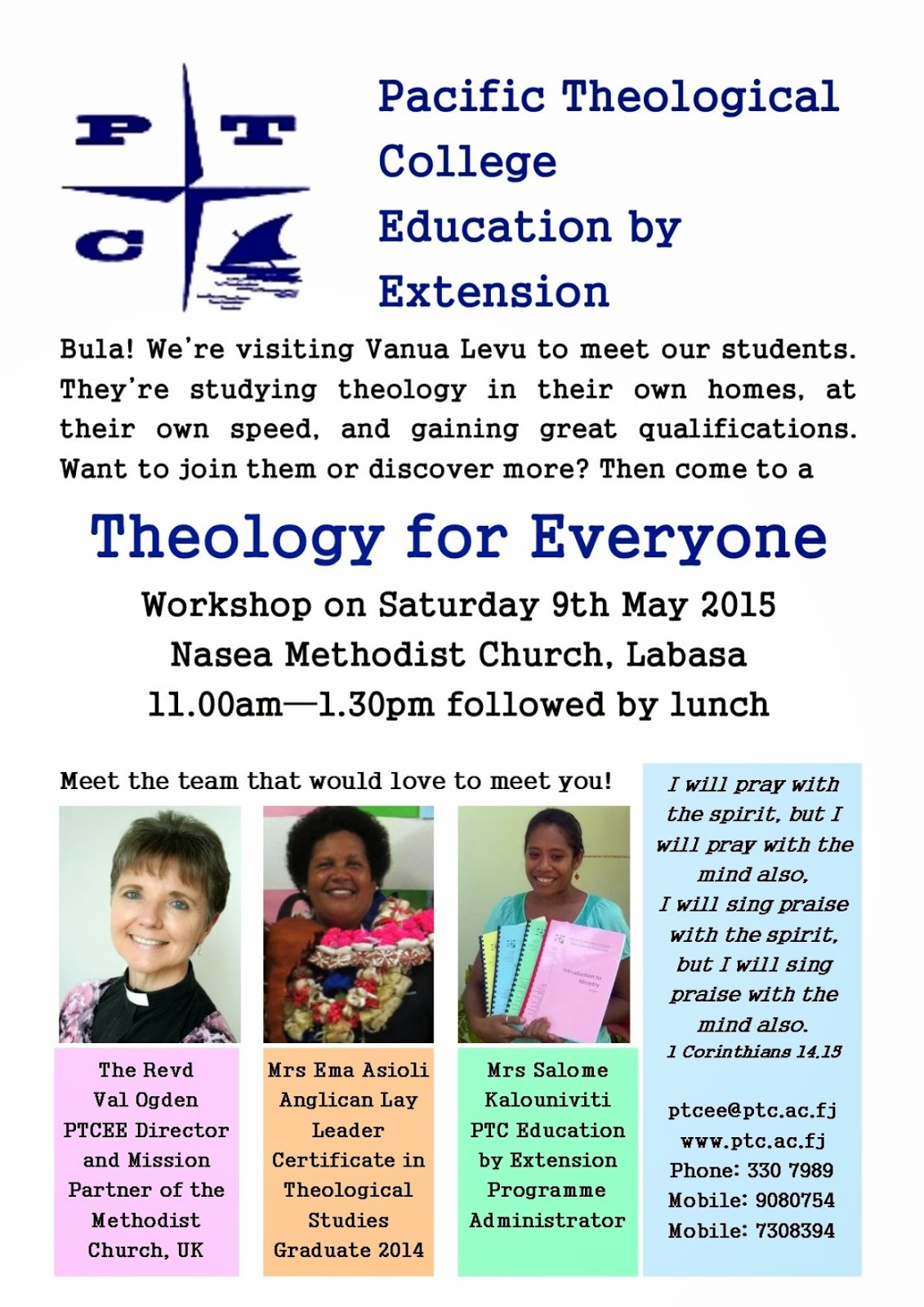
The road to Labasa has one or two flooded and forlorn parts and the big bus has to wibble-wobble a touch carefully over some tiny, creaking bridges with gushing brown water underneath, but predominantly it was an excellent run with a star driver. The 'we', by the way, comprised Mrs Salome Kalouniviti our Administrator in PTC's Education by Extension Department,  Mrs Ema Asioli, a 2014 Certificate in Theology graduate and Anglican lay leader, and the so-called Director of the outfit. Here we are in our matching PTC blue in the grounds of Labasa's Friendly North Inn: which was.


Labasa is the largest and most populated town on the island. It lies about 5 km inland and is the administrative centre of western Vanua Levu: a bustling trade and service township, Labasa has been key in Fiji's sugar industry since the colonial era, with the Labasa sugar mill opening here in 1894. In 2003 a cyclone nearly devastated the area and many farmers are still living with the repercussions and struggling to restore their livelihoods.

We went to Labasa to touch base with those already studying PTC theological courses by extension (correspondence) and to spread the word that we can offer 'Theology for Everyone' - at least if you've got reasonable reading/writing skills in English. 

And the majority of people of course have - and more. In the last seven days I've had conversations with a University of the South Pacific law graduate now a magistrate, the person who heads up child health and nutrition education for Fiji's Ministry of Health, and a Divisional Inspector of Police - all highly equipped and articulate in their professional fields and deeply committed Christians, but who've never so much as looked at a theology course, even for interest. Theological education has been understood, basically, as (a) what the minister/preacher says on Sunday from the pulpit - unlikely to be questioned, and (b) the ability to pluck out an appropriate verse of the Bible as the definitive and sufficient response to any question life may throw at us. I'm deeply admiring in many ways of the capacity to quote Bible chapter and verse so skilfully - a lot better than I can most of the time. It's testament to hours and hours of poring over Scripture and a deep love and respect for the Bible. But 'God so loved the world....' and the world's a complex place where people of faith have to do better than only trading in texts. Or, as we experience too frequently, using them as ammunition for conflict. Theological education takes Scripture, Tradition, Reason and Experience seriously and is crucial in aiding us to account for what we believe convincingly. And if we're scrabbling around looking for a text to authenticate the claim I've just made, 1 Peter 3. 15b-16a would be a start!

...but in your hearts sanctify Christ as Lord. Always be ready to make your defence to anyone who demands from you an account of the hope that is in you; yet do it with gentleness and reverence. 


So what did we do? 

Thursday: Travelled as described above. Settled into our room at The Friendly North Inn and explored the town's  long high street. Always good to note the 'holy ground' of the local post office where our students mail off their assignments to us. We also found Nasea Methodist Church where the Saturday workshop was to be held

We gave thanks for travelling mercies


Friday: planning with our team on the ground at Nasea Methodist Church: including the minister Talatala Rev Noa Turaganivalu, and the amazing and energetic Deaconess Jeta Draunidalo, seen here on the left organising many practicalities by mobile phone. We are so grateful to them. 

Nasea had just finished hosting the Methodist Divisional meetings and were preparing for Mothers’ Sunday but still showed us amazing grace and hospitality.


Saturday: ‘Theology for Everyone’ workshop with present and potential students across Vanua Levu. We were delighted that the Dreketi Anglicans made it! Sairusi Kaiwaidau, Queenie Nivoi and Sekaia Silinatoba are regularly in touch with us here at PTCEE and studying hard.


Here's one of the workshop exercises that we did. Why not give it a go yourself?


Sunday: Preaching, plus participation in Aleeshya's baptism at St Thomas’ Anglican Church in the morning, with kind hospitality from Fr Kelvin Rakesh and family. 

I was asked to offer a blessing to the children and, as it was Mothering Sunday in Fiji, made the connection between parental nurturing and 'Mother Church' nurturing and investing in her children. One of the ways to do that would be, I claimed - perhaps somewhat predictably - through encouraging all ages in their theological education!


Then it was back to Nasea Methodist to speak and share at their afternoon Mothers’ Day service. It was great to participate in this celebration. Women had been practising music and drama for weeks, and were keen to stress that the refreshments afterwards had been arranged for and would be served by the men in the Church. 'Does that happen on other days?' I enquired. 'No Talatala. Just one day a year!' came the response with a wry smile. The sanctuary area was resplendent in gold and white silk including this stunningly dressed pulpit. 


Monday: back to Suva by plane, which only takes 50 minutes. I'd told the team, 'If we can save money by co-habiting in one room at the Friendly North Inn, we can afford a Friendly Fiji Airways return flight!' This met with agreement - and the budget...

It will be important to get out and about more: not just in Fiji, obviously, but to other islands across the region, to connect with students and spread the word about the courses and resources we can offer. 'Theology for Everyone' sounds good on paper, but it needs a theology of presence to make it come alive. 

When Ema gave her 'testimony' (in extempore English, not written down and read out) about what being a PTCEE student meant to her and how she'd achieved a Certificate in Theology, she absolutely radiated delight and new-found confidence. That humanises theological education and speaks volumes to others. It's nothing less than words made flesh, to the glory of God.


Certificate in Theology graduate Ema Asioli on the left, prepares for take off. Can she soar to the heights of a Diploma in Theology next? You bet she can.


Bless you and thank you, good people of God at Nasea Methodist Church....

...and similarly at St Thomas Anglican Church, Labasa.


Tuesday, 12 May 2015

Just when you thought it was safe...

There had been talk, on and off, about an induction service for new Faculty here at the Pacific Theological College, but having started in post on 1st September 2014 I'd come to the conclusion that particular bird had flown. But no. On 1 May 2015, along with colleagues Dr Richard Davies who also arrived last year, and Revds Dr Donald Samuel and Rayappan Isaac who joined the staff in January, we were 'done'! (Perhaps nine months constitutes the 'labour' and now people are expecting to see result(s) come to birth in the Education by Extension Department!)


The Induction process consisted of promises made in a solemn service of worship followed by feasting and festivities with the children of the College providing entertainment. A thoughtful and moving time. My thanks to all involved.

Another thing that came as a surprise to my tram-track British mind was Mothers' Day which is always in March, right? Wrong. It was on 10th May here. Shelley's children appear to have adopted me and I got a splendid card and a tea tray. 


Also in general news, we're a bit overexcited, as you might imagine, about Fiji's success in the rugby sevens. Here's the victory over New Zealand. 


What do I know about rugby? Absolutely nothing, except I know for sure the series moves to London this coming weekend (16 May) with Fiji on 147 points, South Africa on 142 and New Zealand on 139. You can't help getting caught up in it all.


And what of matters theological? Well our department has been travelling - to do a 'Theology for All'  workshop and awareness raising on Fiji's second largest island, Vanua Levu. Find Labasa (pronounced Lambasa) on the map below which is where we were and feel free to join us in the next post. 


Sunday, 26 April 2015

Nanuku - on rising tides

Today, Sunday 26th April, I took Holy Communion Services at Dudley Methodist Church and then at Vatuwaqa. Both are congregations of the Methodist Church in Fiji and Rotuma's Indian Division. I'm regularly on the Plan at Dudley which is pretty much town centre, but was particularly glad to spend time at the settlement church a little further away. The small church itself is in Nanuku, and that's where Seleshni - or Shelley as she prefers - and family live. Here they are outside the family home. Shelley's on the back row in the middle With her Mum on the right and on the left daughter Rosie (who wants to be a Methodist Deaconess - hurrah!) holding Wendy.


A few weeks ago Shelley was looking for some work. We linked up and she kindly agreed to handle domestic work at House 12 on the PTC campus, where I live. She's a God-send, dealing with practical stuff around the home like a breath of fresh air. Her friendly 'can do' approach and her faith inspire me. At the Nanuku Church she's the leading steward and passionately committed to Christ and Christian witness among neighbours and the community. There's a bold, white cross on her front door for all to see.


Nanuku settlement really suffers when it's high tide, and in heavy rains even more. It's right next to mangrove swamps and underfoot becomes a complete mud bath. Shelly's family have arranged huge old tyres off HGVs in a line up to the house to act as a rubber walkway: one of many ingenious and creative solutions to challenging living conditions. 


After church today, Pastor Timoci who offers pastoral care to the congregation and I were invited home for curry and rice and roti etc. And the traditional cup of kava, naturally. Generous and loving hospitality gratefully received.

And there was a baby to be blessed. Shelley's younger sister gave birth to tiny Dev last week and after a short spell in hospital, he's home and the centre of attention. Today held a great deal.

For the families of Nanuku, we thank you God.
Watch over them and sustain them we pray.
May whatever is needful be made tangible,
so that baby Dev and his whole community
may know the fullness of life you promise.  Amen


Goodbye Sydney Hello Steve

Steve Pearce is the Methodist Church's Partnership Co-ordinator for Asia and the Pacific and very good it was to see him too when he spent almost a week here recently. He's a bit like a doctor doing the rounds really: checking up on Mission Partners like me to ensure they're not more trouble than they're worth - quite right too - and reconnecting with people and projects in this area that the Methodist World Mission Fund partners with. You can read Steve's own report by clicking here and scrolling down to April 2015 Fiji Report.


The World Mission Fund has offered a rolling grant to the work of the Pacific Theological College for a number of years now: currently £10,000 annually each to the Residential and Extension programmes. No discrimination there which is great! It also contributes 25% to the current mission partner appointment, ie, me. Too often at the College here, the discourse around overseas Churches and agencies who offer support is entirely about money, and I've found that a bit troubling. So I was delighted that our Principal agreed to Steve giving a hour's presentation to the community - see him in action above - about partnership in mission, and the aspirations we hold about that. For sure, the weight of colonial history, the 'power' that comes with being a funder of anything, and the resources British Methodism can still choose to share or withhold skew the conversation if we're not careful. 


But Steve's presentation emphasising the overriding principle of partnership in mission was well received and generated good questions. For some it didn't go deep enough (he had his ear bent about that!) but for most it was a real window on the wider world Church. Methodists abound here, and so it was of particular denominational interest too and shed a lot of light for local Methodists on how British Methodism and the World Church relationships team relate to this area of the world. I was so grateful to Steve for inspiring PTC with this presentation and so very glad he was able to be more visible to the community. I was absolutely determined not to let him simply be whisked in and out of the finance office! It was lovely to have Steve visit us and his work on the Asia-Pacific desk is firmly on PTC's prayer list. 


New connections: with Ismael Silak from West Papua and Rev Dr Donald Samuel, Faculty member.


Old friends: catching up with Fijian colleagues who have worked or studied in the UK through Methodism's World Church in Britain or Scholarship and Leadership Training Programmes. Front left, back to camera in the brownish shirt, is Rev Akuila Yabaki who used to be based in Methodist Church House, London - doing Steve's job. Global partnership personified.


Saturday, 11 April 2015

More Holy Week in Sydney...

Towards the Cross

As I was saying in the previous post, Holy Week in Sydney was a great time for walking and wondering, pausing and praying. Here's a little more of what I mean....

Striding along the Harbour Bridge out of the city - my first Holy Week outing - I found myself heading appropriately but unexpectedly towards the cross. A white cross, bold and positioned high on a red brick building at Milson's Point. Later research revealed the place to be St Aloysius' College, a Jesuit school for boys dating back to 1548. Here's what the College says about itself in 2015.

Today Jesuit schools are committed to form people of conscience, compassion and competence. Our way of proceeding includes some key themes:
  • Finding God in all things: every aspect of our life and labour can affirm the goodness and presence of God.

  • Cura personalis: we seek to foster a culture of concern and pastoral care where students, staff and families feel accepted for who they are and what they might become.

  • Formation of the whole person: we focus on the intellectual, affective and moral to develop a sense of self-worth and of one’s place in the world.
  • Being men and women for others: we want to show love in deeds and to serve others generously.

  • Engaging with the wider world: we aim to be aware of the challenges of our time.

  • Encouraging excellence: we want to be distinguished for our academic, co-curricular and pastoral provision through which we encourage a bountiful development of gifts for others.

  • Co-operating in the mission of the Church and the Jesuits: we want to witness to Christ’s presence in the world, to find and form Christian community and to participate in Church life. 

  • We seek to serve the needs of the world and the Church especially in the light of the apostolic aims of the Jesuits.

Inspirational aims don't you think? With challenging aspirations for any one of us seeking to be formed by Christ and for Christ in today's world. I particularly like their '3 Cs' - conscience, compassion, competence. 


Movements in Mission


It's years and years since I'd encountered Revd Dr Keith Garner and Carol in their UK days so it was lovely to meet up at Wesley Mission's midweek Easter luncheon and hear Keith on great form at the lectern. They became Australian citizens in 2009 and have devoted themselves with passion to Wesley - a big set up - which has social justice in Christ's name at its heart. We didn't have the conversation about whether they would term themselves in any way 'missionaries' or 'mission partners'. They've clearly embraced Australia and are well tuned in to Sydney's heartbeat - real Sydney not 'tourist' Sydney. 

The Revd James McLeod made a missionary journey to Australia a few years previously to Keith. A Scottish Presbyterian missionary, he was minister at St Stephen's - now Uniting Church - from 1933-39. I went to St Stephen's to hear their Good Friday offering of Olivet to Calvary - moving and musically accomplished. This window's quote preserves the good Revd James's reflection on his missionary immersion into and appreciation of new surroundings.


But how about this accompanying window for a sting in the tale?


Was he teasing? Or did he live convinced that the beauty of his native land could never be surpassed? Australia would always be second best, even though he'd learned to love it? 

And whose land anyway was he measuring and assessing? I was at Pitt Street Uniting Church, a short hop away, on Easter Sunday and reflected on the words very intentionally placed on sheet one of the service order


We acknowledge the Gadigal clan, part of the Eora nation,
who are the traditional custodians
of the sacred land on which we gather


This serves to highlight the Uniting Church's recognition of 
the pain and damage caused to our country’s native people through settlement and beyond. In 1997, recognising its past mistakes, the Uniting Church made a formal apology to the Stolen Generation. We participate each year in National Sorry Day. 

For more information on justice and community services in the Uniting Church visit the UnitingJustice website or the UnitingCare Australia website.
I've read no history of James McLeod and so have no extra insight or take on this one sentence of his commemorated in glass. It just struck a chord with me, a newish mission partner in Fiji, for whom new and precious places are being discovered daily. McLeod's window spoke of 'beauty', and that's a deep concept to process in itself. Whom and what do we treasure as beautiful and why? Will England's green and pleasant land always rate more highly for me than Fiji in the beauty stakes? And by what criteria would I ever compare them?


Bluebells at Leith Hill near Dorking, Surrey in the UK


Fiji flowers in Thurston Gardens, Suva just down the road from PTC

I wondered as I wandered... and not least at the commemorative plaque beneath my feet just before the Harbour Bridge.